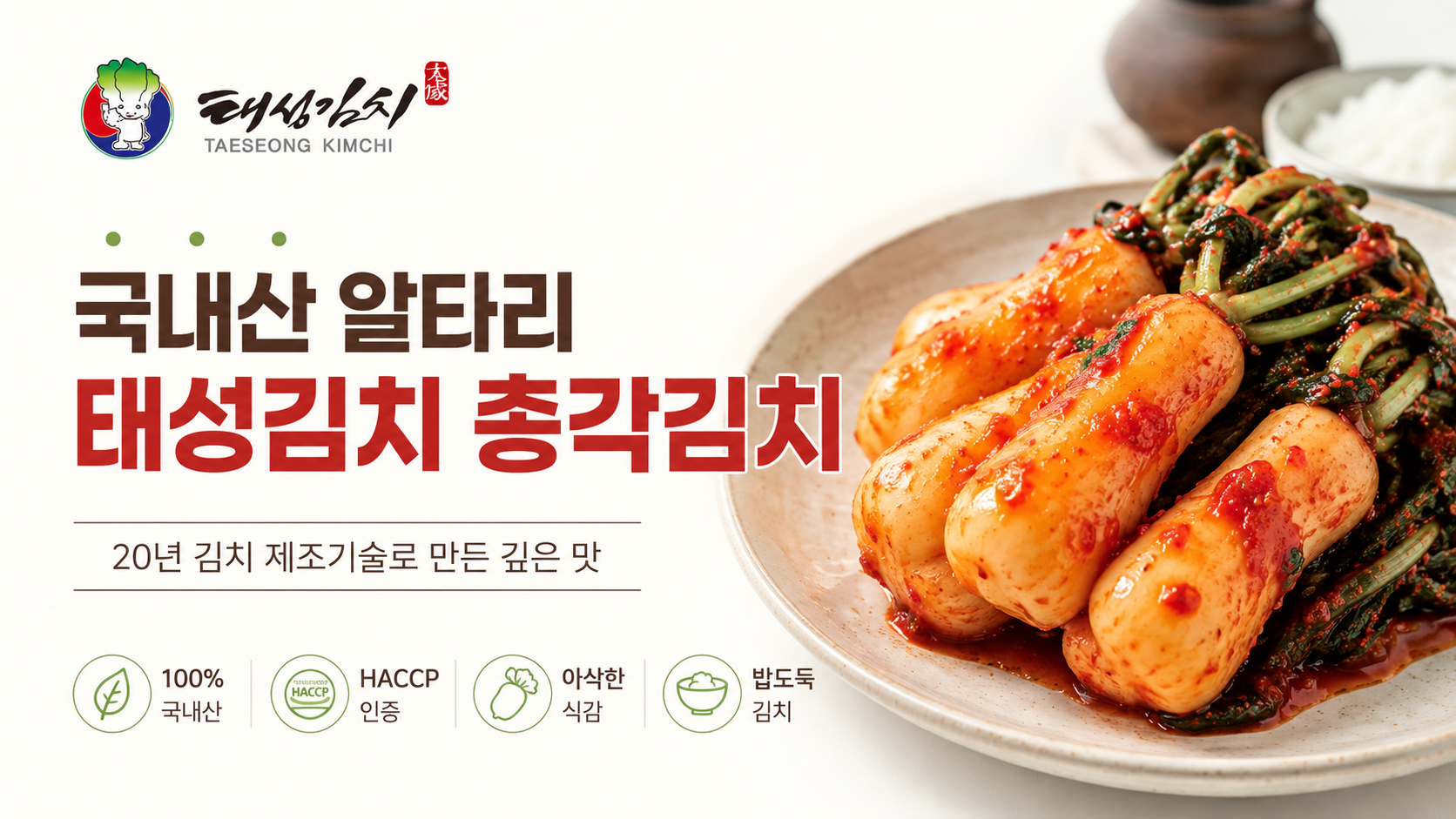
bachelor kimchi, why do you look for domestic products?
When choosing kimchi, the first thing to check is the country of origin. In particular, in bachelor kimchi, the taste and texture of the altarimu itself are important, so the difference in quality of raw materials is felt to be greater than expected.
I tried the Taesung Kimchi and Chonggak Kimchi , which I had even more faith in because they only use domestically produced Altari. I was able to choose with confidence because it was made from 100% domestic , not Chinese raw materials.
What is the difference between Taesung Kimchi and Bachelor Kimchi?
Taesung Kimchi is currently producing a variety of kimchi at its Jecheon and Pyeongtaek production facilities based on its kimchi manufacturing know-how that has been in place since 1999.
We have HACCP certification as well as various quality certifications such as ISO9001, ISO22000, ISO45001, traditional food certification, and halal certification, so we pay attention to hygiene and quality control.
Above all, I was impressed by the fact that they maintained the freshness of the raw materials by using domestic agricultural products grown under contract.
Is the texture really different because it is a domestically produced Altari?
The texture of Chonggak kimchi is more important than anything else.
Taeseong Kimchi's Chonggak Kimchi had such a lively texture that you could hear the sound 'crunch' when you took a bite.
It maintains Altari's unique firm texture but is not too tough, making it easy for anyone to eat.
The seasoning was not excessive, so the original taste of Altari was preserved well, and the more I ate it, the more I felt the clean umami flavor.
How did it feel to actually eat it?
At first, I just took it out as a side dish, but after eating one piece, I kept reaching for it.
Especially when eaten with warm white rice, there was no need for any side dishes.
The salty yet refreshing taste is in perfect harmony, so it was natural to say that is truly a rice thief even when eaten with plain rice.
It goes well with ramen, boiled pork, and pork belly, but personally, I was most satisfied when eating it with freshly cooked rice.
How do people who actually purchased it evaluate it?
If I were to describe in one word what I felt when I actually tried it, it would be , “the bachelor kimchi I want to repurchase” . Looking at the reviews of the
, there were many opinions as follows.
- It's not too spicy so I keep eating it.
- The crunchy texture lasts for a long time. I order
- believing that they are domestically produced.
- It is not made in China, so you can eat it with peace of mind.
- As it ripens, the flavor gets better.
- My parents also said it was delicious so I ordered it again.
- They match so well that a bowl of rice disappears in no time.
Satisfaction was particularly high among those who valued domestically produced raw materials. Can we trust the
production process?
Taesung Kimchi is produced through a systematic process from warehousing to pickling, washing, sorting, dehydration, stuffing, metal detection, and packaging.
The method of separating and washing radish and radish greens is said to be a process that takes hygiene into consideration.
It was also felt to be an advantage that product quality was maintained consistently thanks to this production system. Would you recommend
to these people?
- Those looking for domestically produced kimchi
- Those who feel burdened by Chinese kimchi
- Crunchy Altari Those who like texture
- Those looking for kimchi to eat with the family
- Those who want delicious kimchi as a side dish
- Those looking for reliable HACCP certified kimchi
Finishing
Bachelor kimchi must be made from good raw materials to maintain its taste for a long time.
Taesung Kimchi Chonggak Kimchi uses , 100% domestically produced Altari , and has various quality certifications and a systematic production process, so I had more confidence in it.
When I tried it myself, I liked the combination of the crunchy texture and the clean seasoning, and was especially satisfied when eating it with warm rice.
If you are looking for domestically produced bachelor kimchi, I think this is a product worth choosing at least once.
Q & A
Q. Is Taesung Kimchi’s Chonggak Kimchi domestically produced?
Yes. The main raw materials, including radish, are 100% domestically produced and .
Q. Do you use Chinese raw materials?
No. This is bachelor kimchi manufactured using domestic raw materials.
Q. Why is the bachelor kimchi cut?
Because it uses a large shank, it may be cut into pieces to make it easier to eat and is not defective.
Q. Are there cases where the radish is separated?
Yes. Because radish and radish greens are washed separately for hygienic cleaning, they may be separated when delivered.
Q. How should I store it?
It is recommended to keep the product refrigerated after receipt, and you can enjoy various flavors depending on the degree of ripening.
Source: Taesung Kimchi , Taesung Kimchi Blog , Taesung Kimchi Naver Blog , Web Support Center Blog , Web Support Center Naver Blog
#Bachelor Kimchi #Domestic Bachelor Kimchi #Altari Kimchi #Domestic Kimchi #Taesung Kimchi #100% Domestic #Kimchi Recommendation #Rice Thief #HACCP Kimchi #Kimchi Review