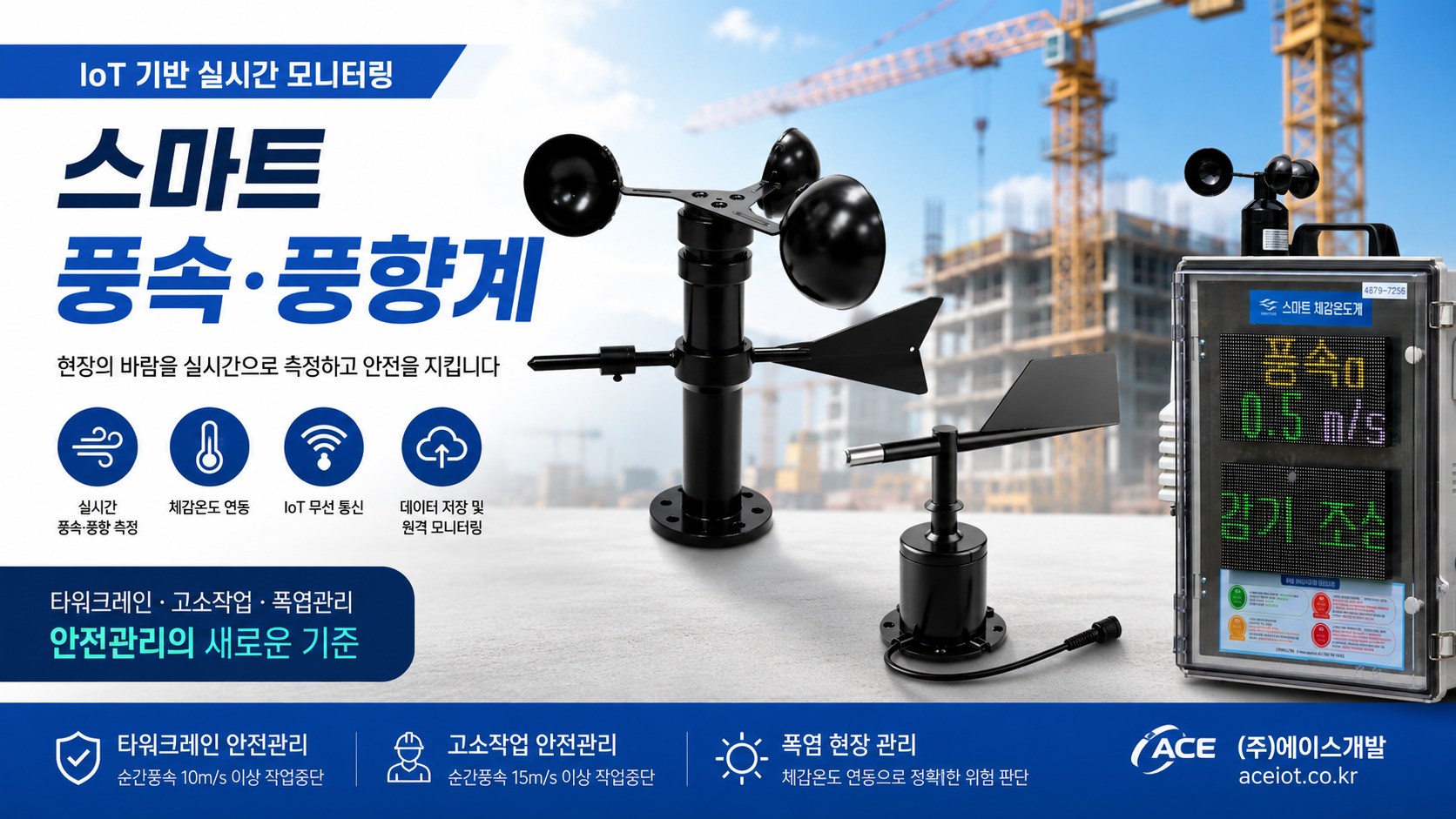
When you are responsible for safety management at a construction site, you encounter problems more often than you might think. It's the wind.
Visible dangers, such as heat waves or cold waves, can be easily recognized, but since wind speeds change instantaneously, they are often judged based only on how one feels on the spot. Especially in high-altitude work such as tower crane work, steel frame installation, or curtain wall construction, wind speed is directly related to safety accidents, so accurate measurement and recording are important.
Recently, I heard that the introduction of smart wind speed and wind vanes is increasing at various sites, so I took a look at Ace Development's wind speed and wind direction monitoring system. What is different about
smart wind speed wind vane?
Most existing anemometers simply displayed wind speed.
However, the biggest difference is that the smart wind vane collects wind speed and direction data in real time and can check it on a platform or mobile device through wireless communication.
Ace Development System measures wind speed and direction data and enables real-time monitoring by linking with RS-485 communication or LTE-based platforms.
Field personnel as well as the headquarters safety team can check data remotely, increasing management efficiency.
Why is wind speed data important at construction sites?
Wind speed at a construction site is not just weather information.
Especially in tower crane work or steel structure work, it is necessary to determine whether to stop work based on wind speed standards.
In the past, we often relied on data from the Korea Meteorological Administration or visual judgment, but actual on-site wind speeds can vary significantly depending on surrounding terrain, buildings, and structures.
Therefore, it is more accurate to make decisions based on data measured directly in the field, and it is also advantageous in terms of preventing accidents and securing safety management records.
Why is wind speed necessary for managing perceived temperature?
Recently, as the obligation to respond to heat waves has been strengthened, the importance of managing perceived temperature has increased.
Many people think that perceived temperature is calculated only from air temperature and humidity, but in reality, wind speed is also one of the important variables.
Even under the same temperature and humidity conditions, the perceived temperature can vary greatly depending on the strength of the wind.
Ace Development linked wind speed data to perceived temperature calculation to enable more accurate on-site environmental analysis. Thanks to
, it was impressive that tower crane safety management and heat wave response could be operated as one system. What are the product specifications of
? The main specifications of
Ace Development anemometer are as follows.
- Measurement range: 0.5~50m/s
- Initial wind speed: 0.5m/s
- Accuracy: 0.5m/s or less or 3% F.S
- Power: DC 12V
- Output: 4~20mA
- External communication: RS-232
wind vane can measure 8 directions and supports RS-485 communication.
integrated wind vane can measure wind speed and direction simultaneously and supports a range of wind speeds from 0 to 30 m/s and wind direction from 0 to 360 degrees.
can also be used from -30 degrees Celsius to +80 degrees Celsius, making it suitable for construction and industrial site environments. What are the advantages of
when applied in actual field?
Personally, the part that caught my eye the most was the data recording function.
When working on safety management, management history is more important than whether or not an accident occurred.
Objective data must remain on when wind speeds increased, whether work was stopped, and what measures were taken. The
Ace Development System appears to be highly useful for future safety inspections and management ledger creation because it can automatically save measurement data on the server and check it on the platform.
It is believed to be particularly useful in sites where wind speed changes are large, such as tower crane operation sites, coastal areas, or highlands.
What if you are considering introducing a smart wind speed anemometer?
In conclusion, the smart wind speed anemometer is not a simple measuring device, but is closer to a safety management solution that manages the weather environment in the field with data.
Wind speed and direction can be measured in real time and even linked to perceived temperature, making it suitable for recently strengthened construction site safety management standards.
I think it is a system worth considering, especially for work that is greatly affected by wind, such as tower crane operation sites, steel construction sites, and curtain wall construction sites.
We live in an era where safety must be managed with data, not experience. I felt that the smart wind vane was a device that could be the starting point.
Source: Ace Development , Ace Development Naver Blog , Web Support Center Blog , Web Support Center Naver Blog
#IoT anemometer #wireless anemometer #sensible thermometer #smart sensible thermometer #heat wave response #heat-related illness prevention #site safety management #ace development #SENSOLINK #construction IoT #weather monitoring #safety management solution